What one personalised LinkedIn ad teaches us about the difference between a gimmick and a strategy
Last week an ad stopped me mid-scroll. Not because of the car. Because of my name.
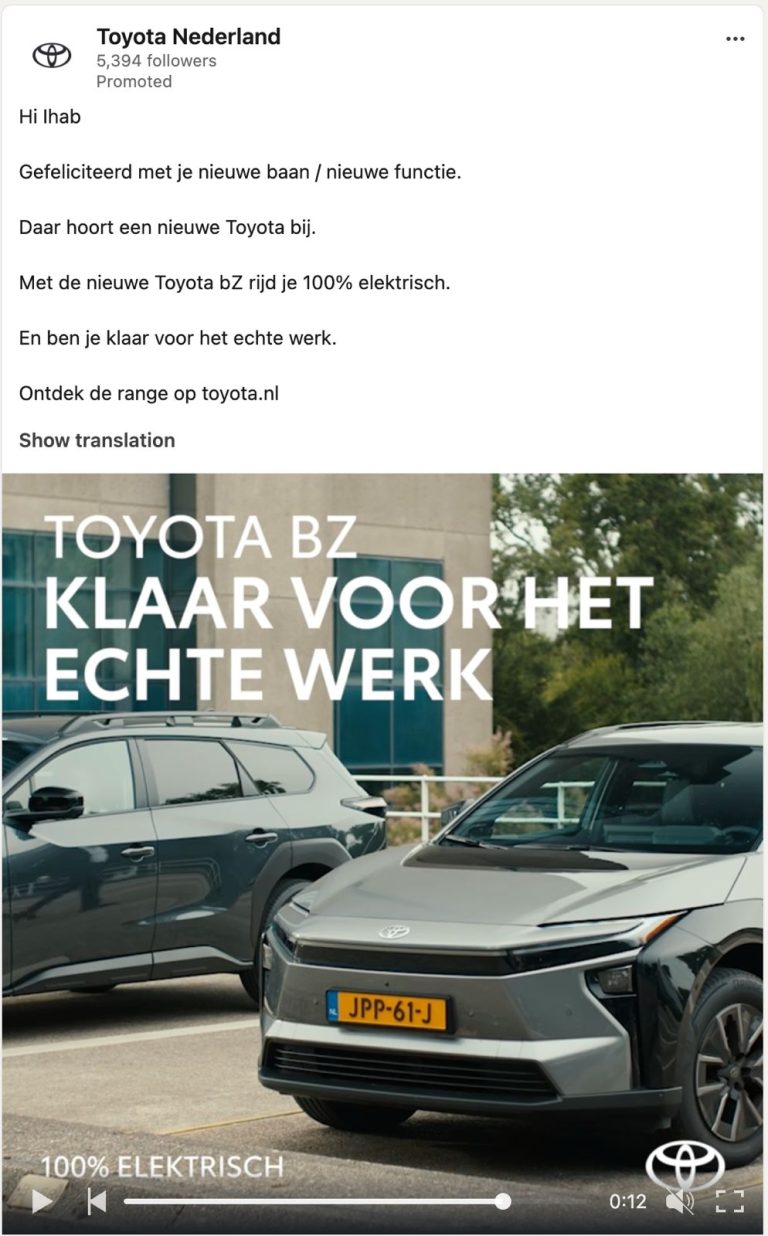
There it was, in a promoted post from Toyota Nederland:
Hi Ihab
I will admit it worked. For half a second, a brand of that size felt like it was talking to me and not to a spreadsheet of five thousand followers. That is the magic of good personalisation. It cuts through the noise before your brain has decided whether to care.
Then I read the next line.
Congratulations on your new job / new position.
I do not have a new job. I do not have a new position. I run the same agency I ran last month, and the month before that. So a brand with one of the biggest ad budgets in the country had just congratulated me on something that never happened, and then tried to sell me a 100% electric Toyota bZ to celebrate it.
The name pulled me in. The assumption pushed me straight back out.
The good news, and then the fall
Here is what impressed me before the ad let me down.
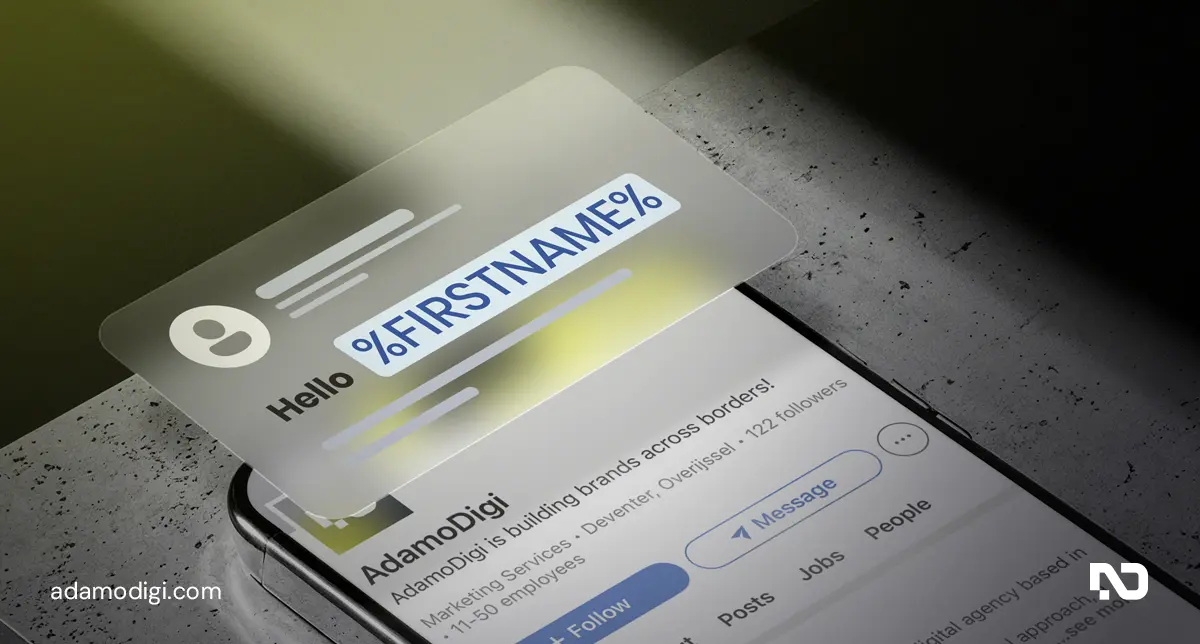
LinkedIn lets advertisers drop personal details straight into ad copy using something called macros. You write a placeholder, LinkedIn swaps in real profile data at the moment the ad loads. Hi %FIRSTNAME% becomes Hi Ihab. And the part I genuinely love: it does not stop at first and last name. You can pull in someone's employer with %COMPANYNAME%, their role with %JOBTITLE%, even their field with %INDUSTRY%. The advertiser never uploads a list of names and never sees your data. LinkedIn does the swap on its own servers when the ad renders.
That is a serious tool. Used with a little thought, it lets you speak to a chief financial officer and a junior designer in two completely different registers, from the same campaign, without ever knowing who is who.
So Toyota had a powerful, still-fresh feature in its hands. And then it did the one thing that turns a powerful tool into an expensive mistake. It guessed.
Nothing in my profile says I changed jobs. The campaign simply decided that a warm, life-event angle would perform, and fired it at everyone, correct or not. That is not personalisation. That is a mail merge wearing a costume.
And it is not cheap. LinkedIn is one of the most expensive places on the internet to buy attention. When you pay a premium to reach someone by name and then open with a fact about their life that is wrong, you do not just waste the impression. You spend more than a plain, honest ad would have cost, and you convert worse than that plain ad would have, because now the reader trusts you a little less than they did three seconds ago. A wrong guess does not land at zero. It lands in the negative.
The lesson is uncomfortable and simple. A name is not a relationship. Personalisation without insight is just a louder way to be wrong.
How we would have written it at Adamodigi
The fix was never to remove the personalisation. It was to stop pretending to know things we do not know, and to use what we actually do know: someone's role, their company, their field. Those are facts sitting right there in the profile. Facts do not need a guess.
Here are three ways we would have run the same Toyota bZ ad. Same feature, same macros, no fiction.
Version 1 — Professional and grounded
Hi %FIRSTNAME%,
The decisions you make as a %JOBTITLE% are never made on paper alone. You want to feel it before you trust it.
So feel this: the silence of a 100% electric Toyota bZ, the instant pull when the light turns green, the tech that quietly does its job.
This weekend, the keys are yours for an afternoon. No pitch. Just the drive.
Reserve your test drive →
Why it works: it never claims to know your life. It uses your role as a compliment, not a guess, and it sells the one thing a spec sheet cannot, the feeling of the drive.
Version 2 — Conversational
Hi %FIRSTNAME%,
Quick one. The new Toyota bZ is fully electric, and it is a lot more fun to drive than the brochure lets on.
People in roles like yours tend to notice two things fast: how effortless it feels, and how little it asks of you afterwards.
Come find out this weekend whether it fits your life. If it does not, at least you had a good drive.
Schedule your test drive →
Why it works: it is light, it respects the reader's time, and it lowers the stakes. "Whether it fits" is a far easier yes than "buy this car."
Version 3 — Company-aware
Hi %FIRSTNAME%,
The people at %COMPANYNAME% make sharp calls every day. Your next car should get the same treatment.
Take the 100% electric Toyota bZ out this weekend and see for yourself why more professionals are making the switch. One drive tells you more than ten reviews.
Book your drive →
Why it works: %COMPANYNAME% flatters without inventing anything. Everyone at that company really does make decisions. You are simply borrowing that pride and pointing it at the car.
Notice what all three refuse to do. Not one of them tells you something about your life that might be false. They congratulate you on nothing. They just take the real signals LinkedIn already hands you, a role, a company, a field, and build a reason to care around them. That is the whole game. Personalisation should make the reader feel seen, not surveilled, and never caught out.
So what actually changed on LinkedIn
Now for the part that makes all of this timely.
On 31 December 2025, LinkedIn officially announced "Drive Action with Real-time Personalization" in its Marketing Solutions product updates. In plain language: the platform can now automatically personalise Sponsored Content ad copy using a member's professional profile information, at the moment the ad is shown.
Here is what is under the hood, and it is worth knowing before you spend a euro on it.
You write with macros, always in uppercase, and LinkedIn substitutes real data at render time:
| Macro | What it pulls in | Example |
|---|---|---|
%FIRSTNAME% |
First name | Ihab |
%LASTNAME% |
Last name | Salha |
%FULLNAME% |
Full name | Ihab Salha |
%COMPANYNAME% |
Current employer | Adamodigi |
%JOBTITLE% |
Current job title | Founder |
%INDUSTRY% |
Member's industry | Marketing and Advertising |
It works across eligible Sponsored Content (single image and video ads), Sponsored Messaging such as Message and Conversation Ads, Dynamic Ads like Spotlight and Follower Ads, and it can prefill Lead Gen Forms.
Three things matter most if you want to use it well.
First, privacy is built in. The advertiser never receives your name, company or job title through a macro. The swap happens on LinkedIn's servers, you only ever get aggregated reporting, and members can switch personalisation off in their settings. So this is not a data grab. It is a rendering trick, and a respectful one.
Second, there is always a fallback. If someone has personalisation turned off, or a field is missing, LinkedIn shows your fallback text instead of a blank space. Which means your generic copy has to be good on its own, because a real slice of your audience will only ever see that version. Write the fallback as if it is the main ad, because for some readers it is.
Third, restraint wins. Hi %FIRSTNAME%, ready to sharpen your workflow? reads like a human. %FIRSTNAME%, as a %JOBTITLE% at %COMPANYNAME% in the %INDUSTRY% industry... reads like a robot showing off. Use one or two macros with intent. Stacking all six does not feel personal, it feels like being scanned.
That is the difference between Toyota's ad and the three above. Not the feature. The judgement behind it.
A powerful personalisation tool does not lower your risk. It raises your ceiling and your floor at the same time. Get it right and you speak to each reader like you know them. Get it wrong and you are paying premium rates to remind five thousand people that you do not.
Make your next LinkedIn campaign the one that lands
Real-time personalisation is one of the most useful things to reach LinkedIn ads in years. It is also one of the easiest to waste, because a wrong guess at a premium price costs you more than an honest generic ad ever would.
That is the exact gap we close at Adamodigi. We build campaigns that use what is true about your audience, and never what merely might be, so the personalisation earns attention instead of burning it.
You want to make the best of your LinkedIn ad campaign.
The official details on LinkedIn ad personalisation: Personalization options for your LinkedIn ads and Create LinkedIn ads with macros.